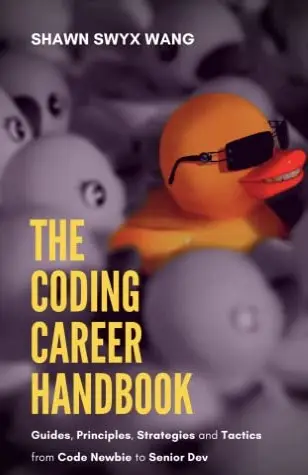
Coding Career Handbook
Table of Contents
How I Discovered Itcopied
I first stumbled upon Swyx's work from Michael Chan's React Podcast in July 2021. I found his career journey very interesting from the podcast. I was immediately intrigued by the unique perspective he has based on his experience. His Learn In Public essay resonated with me and served as a inspiration to start this website. I am also interested in his approaches and strategies for building his personal brand and online community.
Who Should Read itcopied
As the Coding Career Handbook is written right after the author's transition from a junior dev to a senior dev, the book is filled with hard-earned advice on making the same transition ourselves. It is one of the few books that target the niche area of junior to senior transition. (Most software engineering career books revolve around starting a tech career because there is a broader audience base.)
In my opinion, the book is a valuable book for any software engineer regardless of seniority. The author also made heavy use of links to the original content. These links are gateways to different knowledge vaults across the internet, making it worthwhile to discover other related topics.
Podcastcopied
Listen to the author talk about ideas from the book.
Click here for similar podcasts from other authors from my resonance library.
Key Ideascopied
The book is organised the way its subtitle promises — from Principles (durable beliefs) to Strategy (where to aim) to Tactics (what to do on Monday). Below are the ideas that have stuck with me so far; I'm still reading, so this section will keep growing.
Your Coding Careercopied
The book opens with Principles Over Titles: titles mean wildly different things at different companies, so anchoring your career on them is a mistake. Anchor on principles and skills instead. From there swyx maps the territory — Company Types, Career Layers, and The Five Career Stages (from Code Newbie through Junior and Senior, and "Beyond your Coding Career"). The throughline is that the career is a long game played over decades, which is why it rhymes so closely with Apprenticeship Patterns' "Long Road".
Principlescopied
These are the ideas that stuck with me:
- Learn in Public is swyx's signature idea, and the one that inspired this very website. Instead of learning privately and lurking, create "learning exhaust", blog posts, notes, talks, open source, as you go. You get feedback faster, you build a reputation as a by-product, and you become discoverable.
- Pick Up What They Put Down. Volunteer for the work more senior people are dropping. It's a low-risk way to be useful and to learn the parts of the system nobody explains. (The same move Apprenticeship Patterns calls Sweep the Floor.)
- Specialize in the New. When a technology is genuinely new, everyone is a beginner — the experience gap collapses. Betting your attention on something new is one of the fastest ways to leapfrog people with more years than you.
- Good Enough is Better than Best. Pragmatism over perfectionism — shipping a good-enough solution usually beats polishing the theoretically best one.
- Write, A Lot. Writing is the highest-leverage habit swyx pushes; it compounds with Learn in Public.
Strategycopied
The key takeaway for this section are:
- Betting on Technologies. A framework for choosing which tools and ecosystems to invest your limited time in — weighing a technology's adoption trajectory, not just its current popularity. (This is the real, more careful version of "ride the rising tide".)
- Specialist vs Generalist. When to go deep and when to go broad across the arc of a career.
- Profit Center vs Cost Center. Borrowing Patrick McKenzie's distinction: aim to work on the side of a business that visibly makes money, where leverage, budget, and pay concentrate.
- Strategic Awareness & Megatrends. Track the large, slow shifts reshaping the industry and try to position ahead of them.
Tacticscopied
- Negotiating. Most engineers under-negotiate and leave money and growth on the table. Be informed, and ask.
- Lampshading. swyx's term for openly flagging the parts you're unsure about — "hanging a lampshade" on your own gaps — so colleagues can cheaply correct you instead of you hiding what you don't know. (Apprenticeship Patterns calls the same instinct Expose Your Ignorance.)
- Marketing Yourself (without Being a Celebrity). Building a reputation and a network without turning into an influencer — side projects, a developer's guide to Twitter, and writing are the concrete vehicles swyx walks through.
Comments